State economic growth slows in Q4, UMass journal reports
Demographic challenges and softening labor market expected to slow growth in 2026
February 2026
» Access the detailed report

In the fourth quarter of 2025, Massachusetts real gross state product (GSP) increased at an annual rate of 1.0 percent, according to MassBenchmarks, while U.S. GDP increased at an annual rate of 1.4 percent, according to the U.S. Bureau of Economic Analysis (BEA). In the third quarter of 2025, Massachusetts and U.S. GDP grew at annual rates of 3.3 percent and 4.4 percent, respectively, according to the BEA.
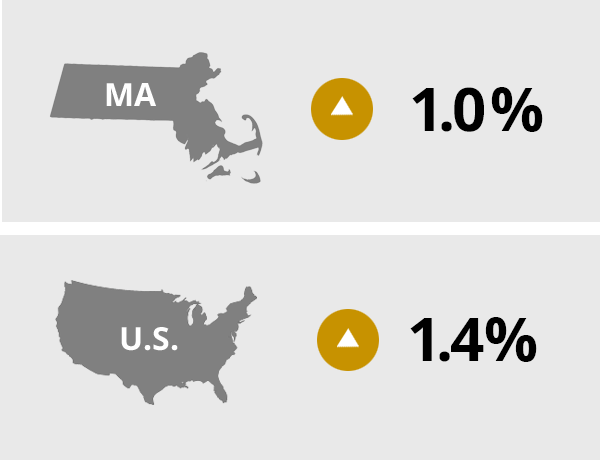 Growth slowed in the fourth quarter of last year as consumer spending slowed from the rapid pace of the third quarter and the government shutdown reduced federal spending. Together, these accounted for most of the reduction in growth in the fourth quarter. Investment spending, including in sectors related to AI, continued to be robust. Massachusetts grew somewhat more slowly than the nation, partly due to demographic and labor-force constraints. These include the Commonwealth’s older population profile, lower levels of international immigration following changes in federal immigration policy and enforcement, and elevated net domestic outmigration, related in part to the state’s high cost of living.
Payroll employment in Massachusetts was unchanged in the fourth quarter of 2025. Nationally, payroll employment declined at a 0.2 percent annual rate in Q4. In the third quarter, employment in Massachusetts fell at a 0.8 percent annual rate, compared with a 0.1 percent gain for the U.S. Relative to the fourth quarter of 2024, employment in Massachusetts was unchanged in the fourth quarter of 2025, while the nation experienced 0.2 percent employment growth over the same period. This likely understates the state's relative weakness. The national figures incorporate annual revisions to the employment data, which lowered estimated employment growth since March 2024 by roughly one million persons. State data revisions are expected in April and are likely to show that employment growth in Massachusetts was weaker than originally estimated.
The state's unemployment rate in December was 4.8 percent, compared with the national rate of 4.4 percent. "The state's unemployment rate is typically lower than that of the U.S. due to its more highly educated labor force, so this higher rate indicates some relative weakness," noted Alan Clayton-Matthews, Senior Contributing Editor and Professor Emeritus of Economics and Public Policy at Northeastern University, who compiles and analyzes the Current and Leading Indexes for MassBenchmarks. In December 2024, the unemployment rate was 4.1 percent in both Massachusetts and the U.S. "This relatively greater rise in the state's unemployment rate partially reflects the ongoing difficulty recent college graduates have had in this low-hire/low-quit labor market," Clayton-Matthews added.
The U-6 unemployment rate, which counts persons who are underemployed—who want full-time but can only find part-time work—and persons who are marginally attached—who want a job but haven't looked in the last four weeks—as unemployed, has also risen. In December, it was 8.1 percent in Massachusetts and 8.4 percent in the U.S., compared with 7.2 percent for Massachusetts and 7.6 percent for the U.S. in December 2024.
Wage and salary income in Massachusetts, as estimated by MassBenchmarks from state personal income withholding tax revenues, grew at a 9.3 percent annual rate in the fourth quarter of 2025. This follows a decline of 1.0 percent in Q3. These estimates highlight the increased volatility of withholding tax revenues since the state’s 4 percent surtax on incomes over $1 million (now $1,083,150 for tax year 2025 after inflation adjustment) was enacted. Relative to the fourth quarter of 2024, this measure of wage and salary income is up 5.5 percent in Massachusetts.
In the third quarter of 2025, BEA's estimate of Massachusetts’ wage and salary income grew at an annual rate of 1.1 percent. In comparison, U.S. wage and salary income grew at an annual rate of 4.3 percent in the fourth quarter of 2025 and was up 3.8 percent from the fourth quarter of 2024, according to the BEA. After accounting for inflation, real wage and salary growth has been positive in both the state and the nation but has significantly lagged productivity growth. This continues a trend of recent decades in which the share of GDP attributed to labor (i.e., wages and salaries) has fallen while the share of GDP attributed to capital has risen.
Inflation, as measured by the Bureau of Labor Statistics’ Consumer Price Index for All Urban Consumers (CPI-U), was -0.6 percent in the Boston metro area in the fourth quarter, compared with 2.5 percent for the U.S. (all metro areas). The corresponding core measure, which excludes food and energy, was -0.4 percent in Boston versus 2.0 percent for the U.S. Year over year from the fourth quarter of 2024, the inflation measures for Boston and the U.S. were nearly identical, at 2.6 percent for Boston and 2.7 percent for the U.S. The year-over-year measures for core inflation were also virtually the same, at 2.8 percent for Boston versus 2.7 percent for the U.S.
The MassBenchmarks Leading Economic Index projects Massachusetts GDP growth of 1.3 percent in the first quarter of 2026 and 0.8 percent in the second quarter (quarterly growth at annual rates). Slower growth in the first half of 2026 reflects several factors. The primary factor is the assumption that the strong rate of productivity growth in the second and third quarters of 2025 will decline to a more moderate 1.6 percent rate, consistent with the Wall Street Journal’s survey of economists in January. This assumption is consistent with a recent uptick in initial unemployment claims in Massachusetts and relatively weak wage and salary income growth in the third quarter of 2025—both indicators that tend to lead the broader economy.
» Access the detailed report